 The Distilled
Displacement and FVGs
The fast one-sided move that leaves gaps behind it, what a fair value gap is and is not, internal and external liquidity, and what happens when a gap fails.
Displacement: a move delivered in one go
Some moves are delivered evenly, with candles closing both ways. Others are delivered in one effort: a run of large candles closing the same way, with small wicks against them. That second kind is usually called displacement. On a chart it is the part of the move that looks fast and one-sided. On a lower timeframe the same displacement may be a run of several candles; on a higher one it may be a single large candle. Read it on the timeframe you are trading.
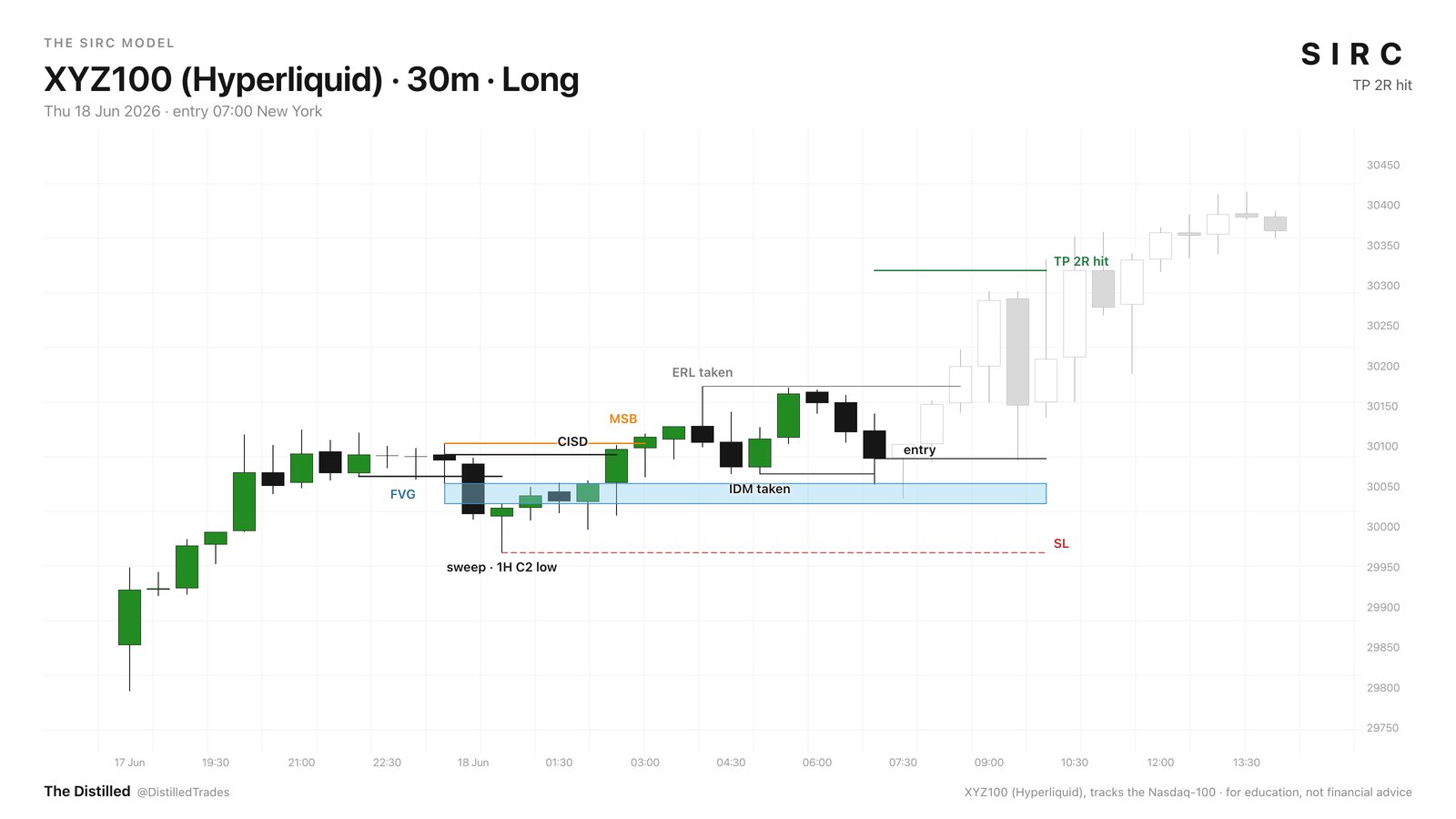
Displacement matters here for a practical reason. Fast moves leave gaps behind them, and those gaps are where the SIRC retest happens. Be clear about what it does not do: in our tests, how forceful the move away from a sweep was made no measurable difference to how often a trade reached its target.
The fair value gap
A fair value gap (FVG) is a three-candle pattern. The middle candle moves so far that the third candle never trades back into the range of the first. In an up move, the gap is the band between the first candle's high and the third candle's low; in a down move, between the first candle's low and the third candle's high. Price crossed that band in one direction without trading it in the other.
Draw the gap from the first candle's wick to the third candle's wick, not from the bodies, and extend it to the right until price trades back into it. The band is the part that was never traded, and wicks were traded.
A gap is a location, not a level that holds. In our tests a gap drew barely more reaction than a band of the same size beside it, so treat it as a place to look.
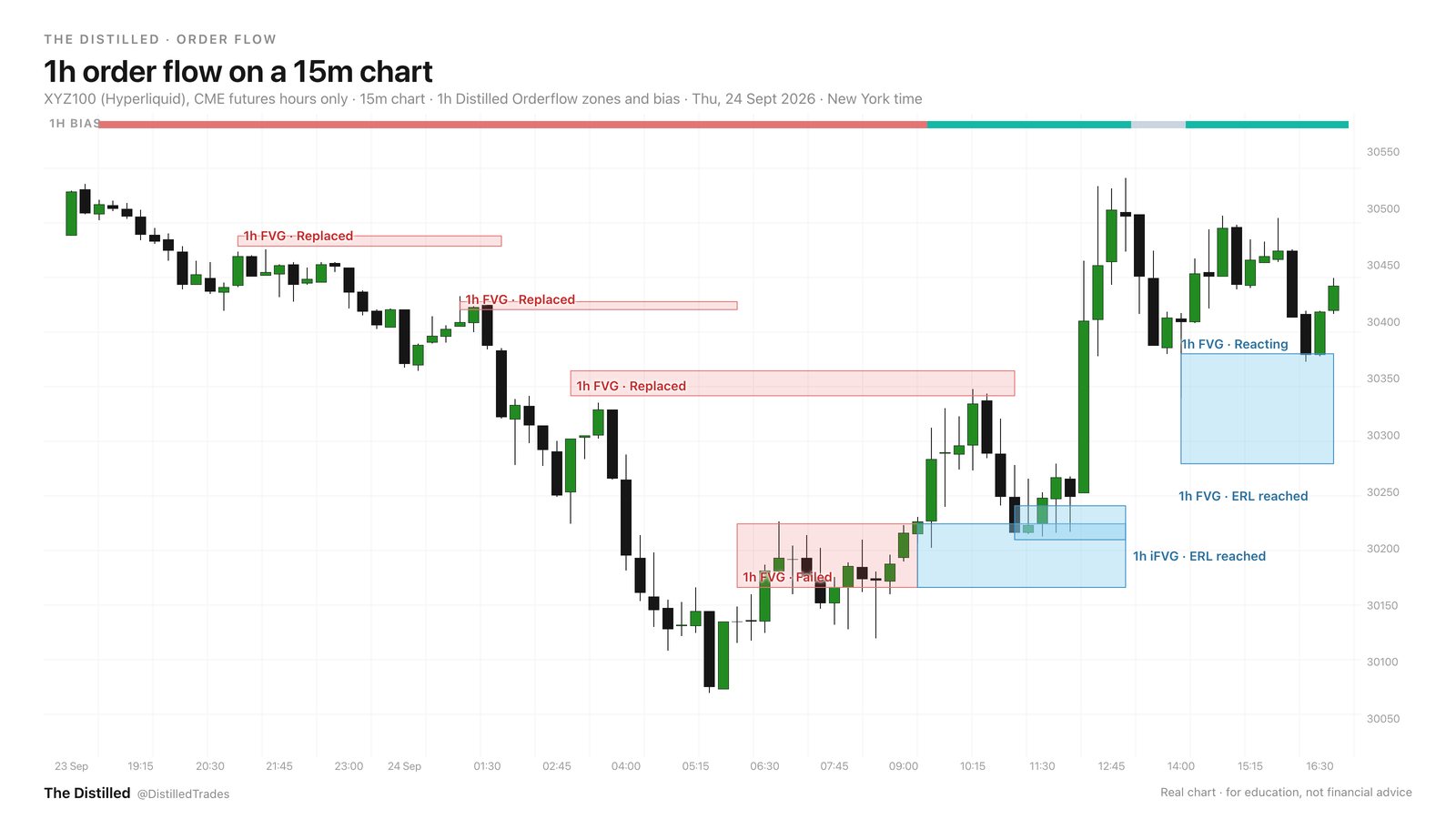
A gap also has a life. Untouched: it has formed and price has not come back. Tapped: price has traded back into it. Reacting: after the tap, price closes back out the way the gap faces, the only state that says anything happened there. Done: price reached the objective beyond it. Failed: price closed beyond the far side.
IRL and ERL
Two kinds of liquidity show up in almost every move. External range liquidity (ERL) is the obvious levels at the ends of a range: a swing high or low, a session extreme. Internal range liquidity (IRL) is the gaps inside the leg, left by the impulse as it ran.
Read as a cycle, price leaves one external level, comes back into the internal gaps, and travels to the next external level. That is a frame, not a rule you can trade off. It stops you buying a high that has just been taken because it looks strong, and it stops you reading a normal retrace into a gap as a reversal. In SIRC, the IRL is where you get in and the ERL is a level on the way to the target.
Be clear about why gaps look respected. On our MNQ 30-second study, gaps the impulse left were respected 79.4% of the time against a chance line of 78.7%, and inverted gaps 75.7% against 74.2%. Most of that is geometry: a gap is thin, so a tap is usually followed by a close outside it.
When a gap fails: the inverted FVG
A gap that price closes through is not simply deleted. The side defending it has been overrun, and the same band often acts from the other side on the way back. That flipped gap is called an inverted fair value gap (iFVG).
An inversion is more legible than an untouched gap, because something has already tried to hold there and lost. Legible is not the same as profitable: nothing we tested made the inversion itself a better entry. It also needs a close through to exist. A wick through proves very little.
One habit to keep: if your chart has so many gaps marked that you can always find one near price, they have stopped carrying information. Mark the ones that formed on real displacement and have not been traded through.
- Displacement is a fast, one-sided run of candles. It leaves gaps behind it.
- An FVG is the band a three-candle move crossed without trading back into.
- A gap is a location, not a promise. Only a tap and a close back out says anything happened.
- IRL is the gaps inside the leg; ERL is the extremes at its ends.
- A gap closed through can flip into an iFVG. It needs a close, not a wick.
After the next clear sweep on your chart, draw the impulse leg and mark each FVG it leaves, dashed while untouched. When price retraces, note which gap it came back to first, whether it closed back out or closed through the far side, and whether a failed gap then acted from the other side.
Related on the site
Education only, not financial advice.