 The Distilled
S: the sweep and the break
The first stage in full: which levels count, the sweep and the close back inside, the CISD, and the MSB that completes it.
Which levels count
The S starts at a level worth sweeping. The ones SIRC uses are the ones from lesson 2: swing highs and lows, session highs and lows, the previous day and week, and higher-timeframe candles. A higher-timeframe C2 is a common one. When the last 1-hour or 30-minute candle has left a low, sweeping that low on the 15 or 5-minute chart is a sweep of a level everyone on the higher timeframe can see.
Name the level before price gets there. ‘Sweep of the 1-hour C2 low’ is a read. ‘Price went down and came back up’ is a description written afterwards.
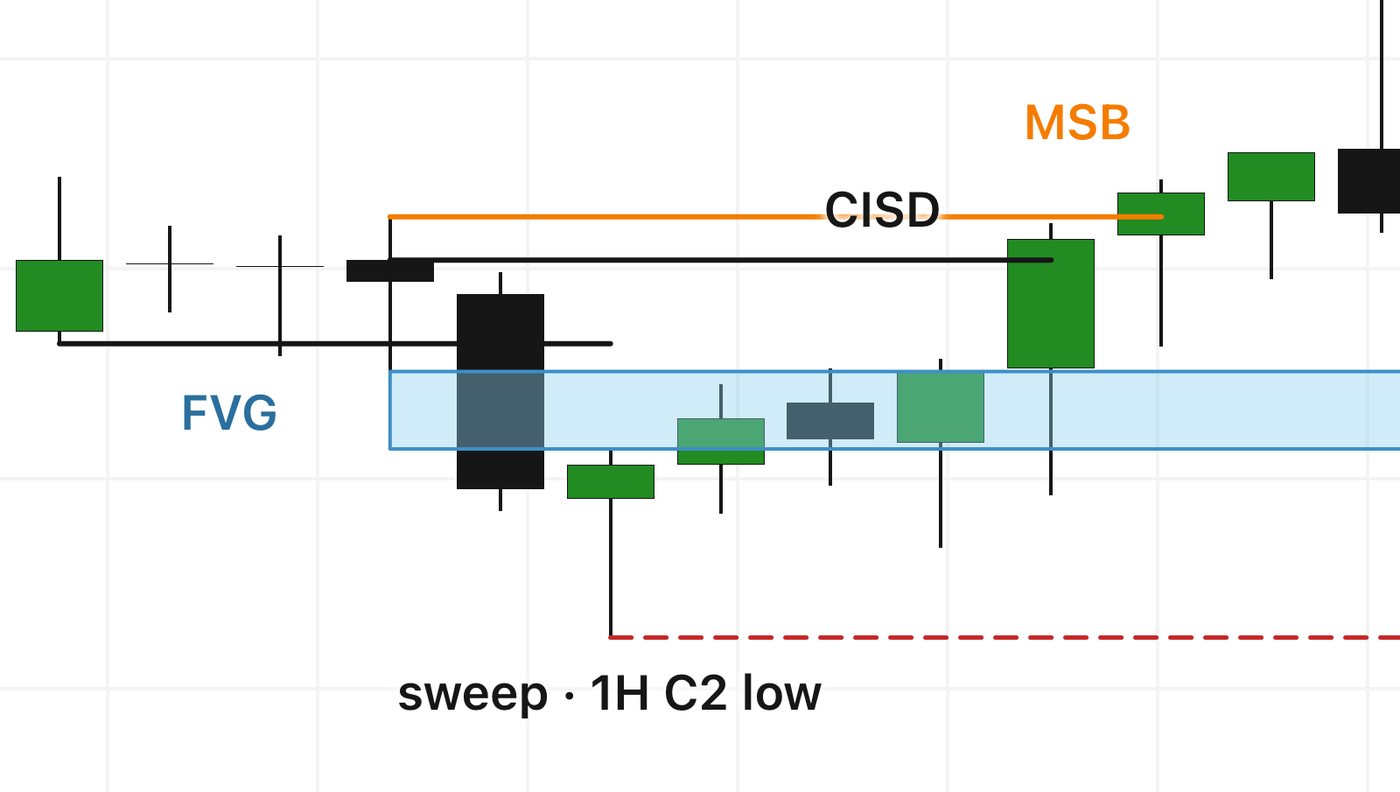
On 18 June 2026 (XYZ100, 30-minute candles), the 1-hour candles had just printed a C2, and its low was the level. The candles at 00:00 and 00:30 New York traded under it, and the 02:30 candle closed back up through both the level and the open of the run that had delivered price into the low. That close was the CISD. The MSB followed on the 03:00 candle, on a close above the last swing high before the sweep.
The sweep, then the CISD
The sweep is a wick through the level and a close back inside within a few candles. A close beyond it that holds is a break, not a sweep, and there is nothing to do.
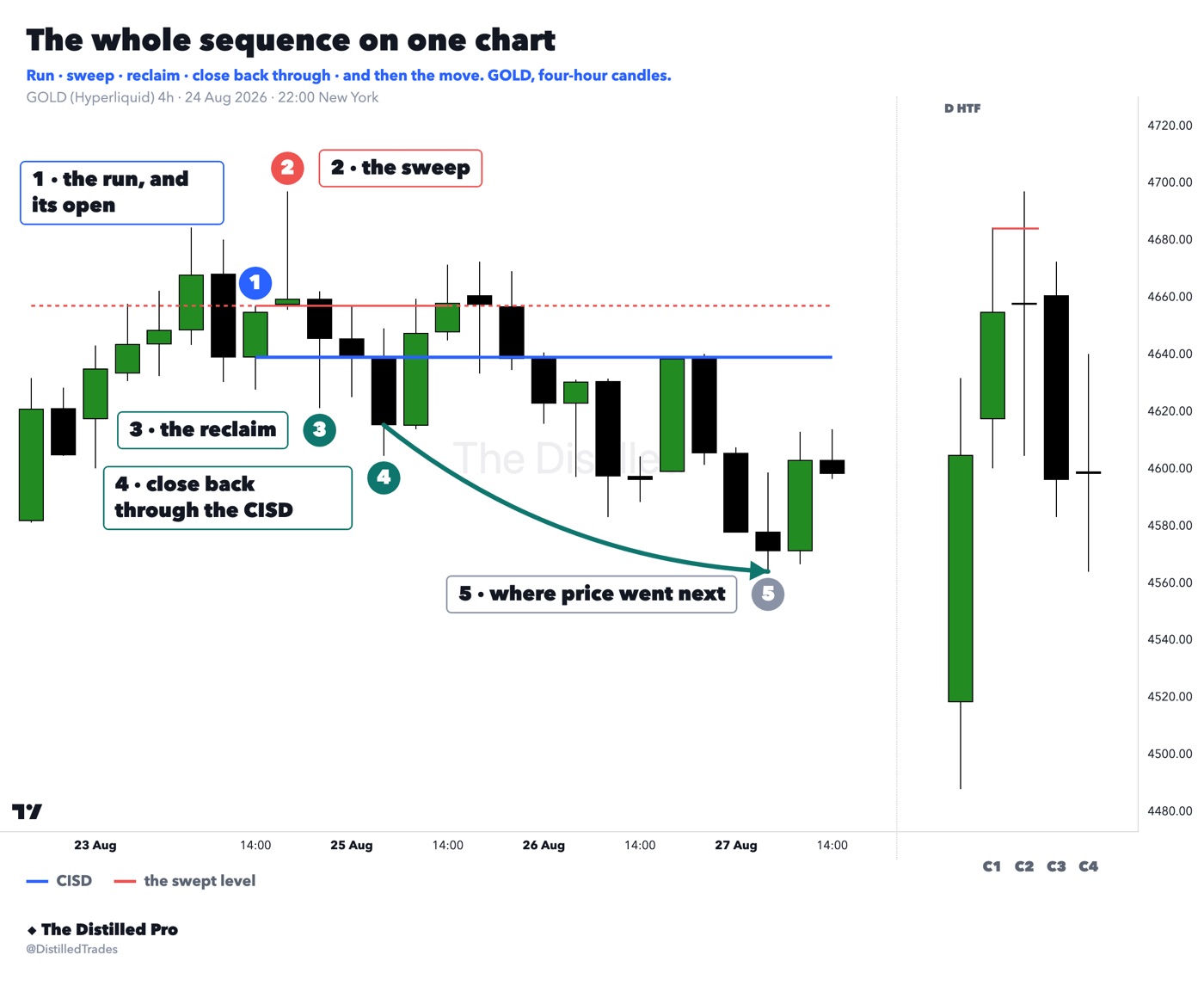
Then the CISD. Find the run of candles that delivered price into the sweep: walk back from the sweep while the candles keep closing in the move's direction, and stop at the first one that closed the other way. The open of the run's first candle is the CISD level. It is an open, not a wick or a close, because the open is the one price in the run that was not simply handed over by the candle before. The CISD confirms when a candle closes back through that open. A touch is not enough.
The reclaim and the CISD are separate events, even when they land close together. About three in four closes through the CISD come on the candle right after the reclaim, and our tests did not find that version doing any worse. It only changes how much of the read you could follow as it happened.
The MSB completes the S
The last piece is the market structure break: a close through the last swing before the sweep. On a long, that is the last swing high before price swept the low. It says the structure that led into the sweep has been taken back, not just the run.
S is complete when the sweep, the CISD and the MSB have all printed. Until then you have a sweep in progress, and the honest state is waiting. A sequence that has not confirmed is not ‘confirming soon’.
From here the sweep's wick is the most important price on your chart. It is the stop for the whole setup and the level that ends it. If price trades back through it before you have an entry, the setup is dead, however good the rest looked.
What the S tells you, and what it does not
The S tells you a level was taken, the attempt failed, the run that delivered it was undone at its origin, and the structure behind it broke. In our testing on roughly 790,000 signals, a sweep followed by a CISD did carry information about whether a turn was genuine. No entry we built from it beat a random entry with the same stop once costs were paid. Knowing a turn is real is not the same as having a price to buy it at.
That is why SIRC does not enter at the end of the S. The close through the CISD usually prints in the middle of the impulse, and lesson 11 shows what that costs. The S gives you a direction and a stop. The entry comes later.
- Name the level before price reaches it. A higher-timeframe C2 is a common one.
- Sweep: a wick through, a close back inside. A close beyond that holds is a break.
- CISD: the open of the run's first candle, confirmed by a close through it.
- MSB: a close through the last swing before the sweep. All three complete the S.
- The sweep's wick is the stop. If it trades before an entry, the setup is dead.
Open a bare chart and find a decisive turn. Walk back to the run that delivered price into the sweep and draw one line at the open of its first candle. Mark the last swing before the sweep. Then step forward a candle at a time and write down which printed first, the close through the CISD or the close through the swing, and how many candles apart they were. Do it on twenty turns.
Related on the site
Education only, not financial advice.