 The Distilled
C: the continuation
Managing the trade once you are in: the 2R target, the ERL as a reference level, the stop that never moves closer, and a real SIRC trade that was stopped.
The target is 2R
The target is fixed before the entry: twice the distance from the entry to the stop. It is not a level price is drawn to. It is a choice about risk, and it sets your chance line. At 2R, a market with no edge hits the target about 1 time in 3.
Why 2R rather than the next big level? Because a target chosen once you are in the trade, when you can see where price is going, is not a target. It is a story. Across our tests, how often a target was reached depended on its distance, about 1/(1+k), whatever kind of level it was. So fix a distance, write it down and leave it alone.
The ERL on the way
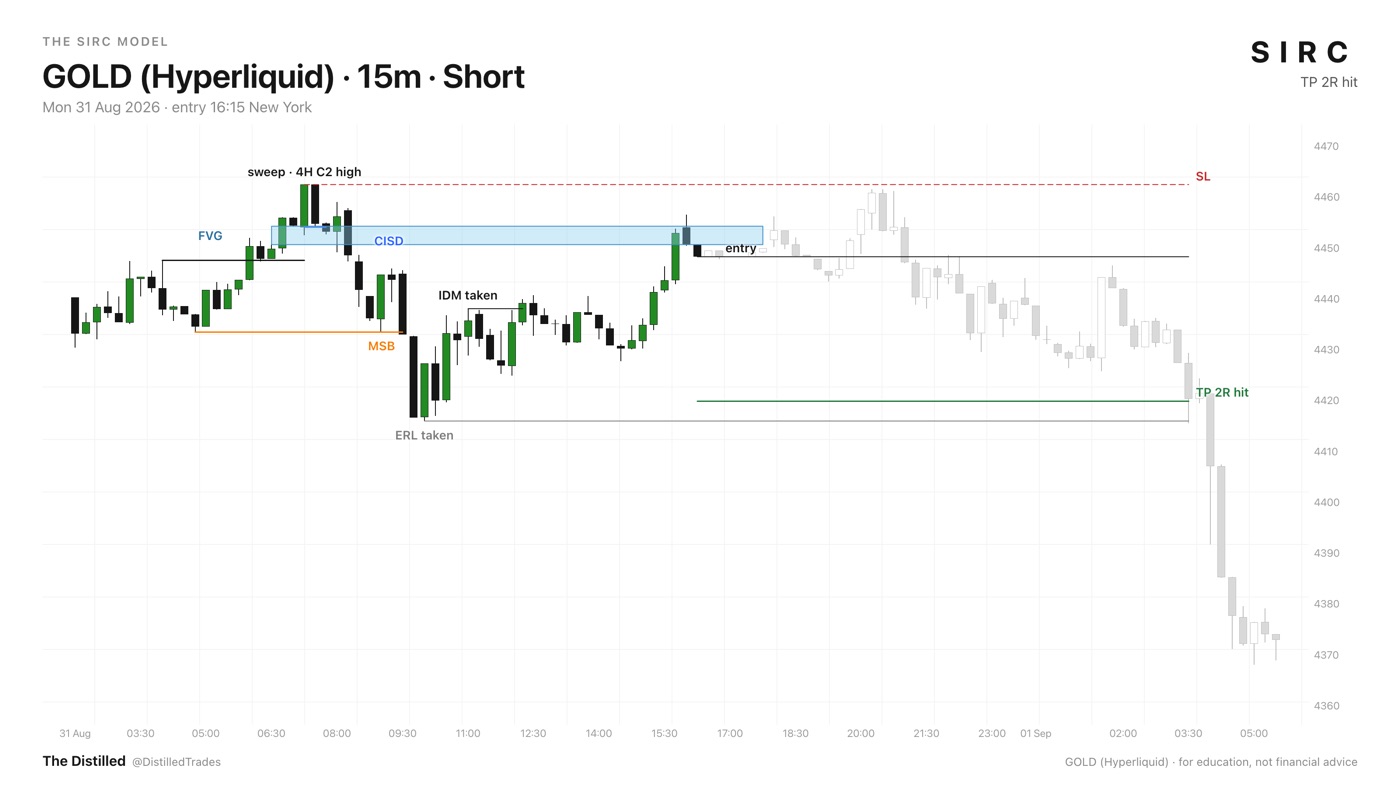
The ERL, the extreme of the impulse leg, is drawn as a level. On a long it is the high of the move. Where it sits against the 2R target varies from trade to trade. On the 18 June 2026 long it sat well below the target, so price took it on the way. On the 3-minute long from 16 September 2026 it sat just below the target, and price took both on the same candle. On the 31 August 2026 gold short it sat just beyond the target, and price went through both on the same drop.
The ERL is a reference, not a second target. Do not bank the trade there because it feels like a natural place to stop, and do not move the target further out because price went through it easily. If you want to manage trades differently, decide it in writing before the entry and apply it the same way every time.
The stop never moves closer
The stop sits beyond the sweep's wick and stays there until the trade ends. It is never moved closer before the target, and it is never moved further away. Moving it further away turns a defined loss into an undefined one. Moving it closer, including to break-even, takes you out of trades that would have reached their target.
On the 18 June long, the 09:00 candle reached 30,293, 26 points short of the 2R target at 30,319. The 09:30 candle then fell back to 30,083, two points under the entry, and the 10:00 candle went through the target. A trader who had moved the stop to break-even would have been taken out on that pullback, and one who had moved the target would have had a different result from the same read.
If the stop is hit, the setup is over. No second entry. The trade after a loss is the most emotionally expensive one you will take all week, and it is rarely a setup.
A SIRC that was stopped
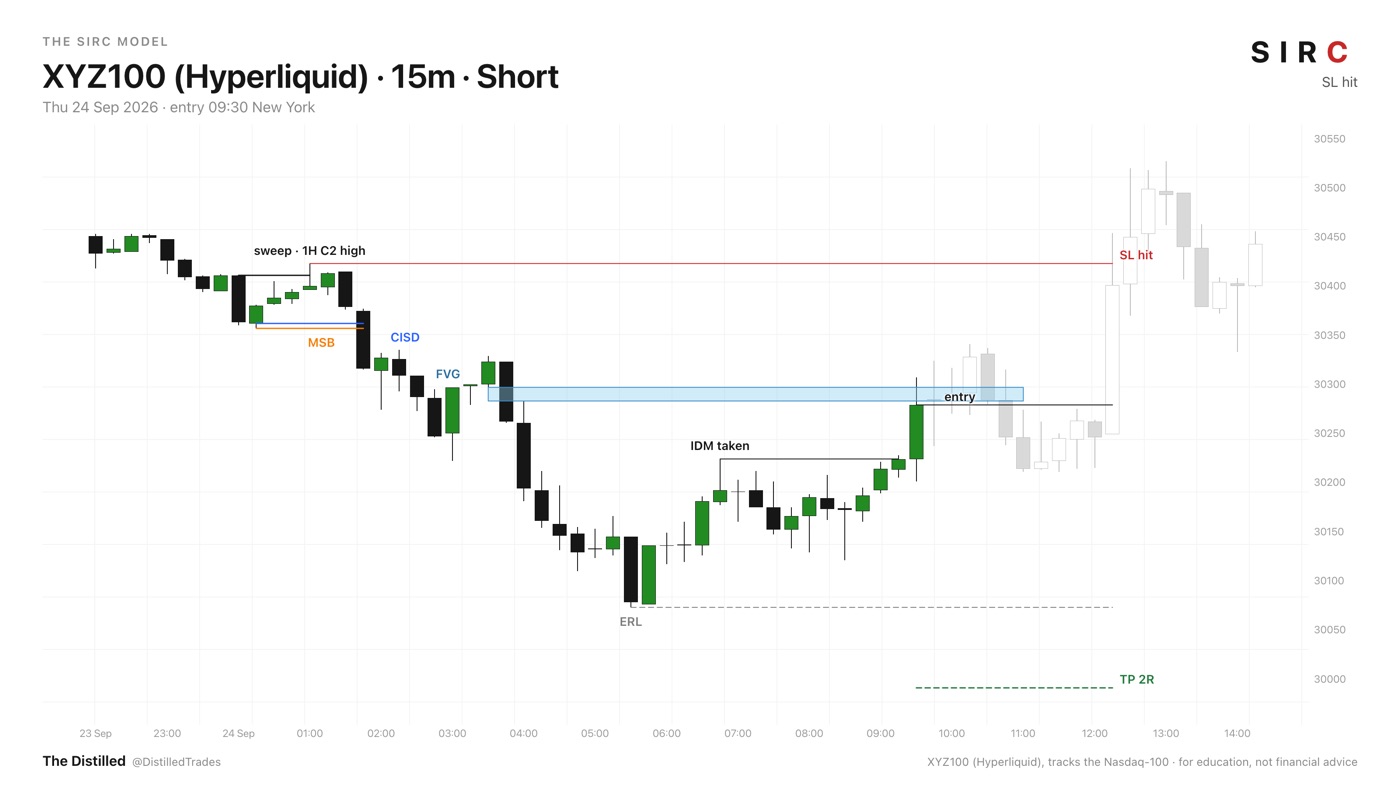
Here is the one that did everything right and lost. On 24 September 2026, XYZ100 swept a 1-hour C2 high at 01:00 New York. The CISD and the MSB printed, the IDM was taken, and price tapped the FVG and closed back out at 09:30: a textbook entry. Then price traded straight back through the sweep's high before reaching 2R. Stopped.
There was nothing wrong with the reading and nothing to fix. At a 2R target, two in three correct trades lose, and those two are not mistakes. The stop did exactly what it was placed to do. What would have turned it into a bad trade is a stop moved further away, a second entry to win it back, or a bigger size because the setup looked clean.
Losing trades are part of the plan. Taking them small is the skill.
After the trade
Whatever happened, log it before you look at anything else: which stages printed, the entry, the stop, the target in R, whether it hit 2R or the stop first, and whether you followed the plan. Then judge the decision by what you knew when you made it, not by how it turned out.
A win that broke your rules is still a mistake, and a loss that followed them is still a good trade. Over enough trades, the record of decisions is what tells you whether the model is worth your time. Lesson 15 covers how to keep that record honestly.
- Target 2R, fixed before the entry. The chance line at 2R is about 1 in 3.
- The ERL is a level on the way, not a second target.
- The stop stays beyond the sweep: never closer, never further.
- A stopped setup is over. No second entry.
- A correct trade can lose. At 2R, two in three do.
Take every SIRC setup you have marked so far, winners and losers. For each, write the target in R before you look at the outcome, then record whether it hit 2R or the stop first, and whether the ERL was taken on the way. Add up the hits and compare the rate with 1 in 3.
Related on the site
Education only, not financial advice.