 The Distilled
Why not enter on the CISD break?
Most of us learned to enter on the close through the CISD. Where that close prints, what we measured on 123,978 entries, and what waiting for the retest does and does not change.
The entry most people learned
The CISD is usually taught as the entry: price sweeps a level, closes back through the CISD, and you get in on that close with the stop at the sweep. It is a clean rule, and the CISD is a real confirmation. The question is whether its close is a good place to get in.
Look at where that close usually prints. It tends to arrive in the middle of the impulse, often on the biggest candle of the move. Entering there means buying after a large part of the move has already happened, with the stop all the way back at the sweep's wick.
There is a simple reason for that. The CISD level is the open of the run that delivered price into the sweep, so the confirming candle has to travel from the wick back up through the whole of that run before it can close beyond it. The first move away from a sweep is often the fastest. By the time the close prints, a good part of the impulse is already behind it.
What we measured
We took every CISD continuation entry on NQ, ES, gold and Bitcoin, on the 1, 3, 5 and 15-minute charts: 123,978 entries. For each one we asked how far price came back against the entry before it moved 1R in the trade's favour. Stopped trades count as having come all the way back.
67% came back at least half-way to the stop first, and 79% came back at least a quarter of the way. The figure barely changed across markets and timeframes: between 64% and 68% in every one.
The pullback is not a sign the entry was wrong. It is what an impulse usually does: it leaves gaps behind it, and price tends to come back into them before it continues.
Order flow does not remove it
A common reply is that the pullback only happens when the trade is against the higher timeframe. It does not. With the order flow one timeframe up aligned with the trade, 66% of entries still came back half-way to the stop. Against it, 67%.
So a filter on the higher timeframe does not change where the break prints. Waiting does.
Notice what the 67% does not say. It does not say those trades lost; many came back half-way and then went on to their target. It says that if you enter on the break, you should expect to sit through a pullback most of the time, and plan your size and your nerves for it.
What SIRC does instead, and the honest cost
SIRC keeps the CISD as confirmation, not as the entry. It waits for the MSB and for the inducement to be taken, then enters on the close back out of the gap. The stop stays in the same place, beyond the sweep. Because the entry is closer to the stop, the risk is smaller. On 4,018 setups where both entries existed on the same sweep, the SIRC risk was a median 27% smaller.
On the 18 June 2026 chart (XYZ100, 30-minute candles), the CISD-break entry was 30,097 and the SIRC entry 30,085, with the same stop at 29,968: 129 points of risk against 117. The CISD-break entry sat through a 44-point pullback before the SIRC entry even existed. Here the saving was 9%, smaller than the median.
Now the part that matters just as much. These numbers describe where price went. They do not say either entry wins more often: on our data both sit near their chance line, about 1 in 3 at 2R. And waiting has a cost. Sometimes price never comes back and SIRC misses the trade entirely. That is a missed trade, not a loss, but you should expect it.
If you still prefer the break, the rest of the plan is the same: the stop beyond the sweep and a fixed 2R target. What changes is the size. A wider stop means a smaller position for the same money at risk, and a 2R target that sits further away.
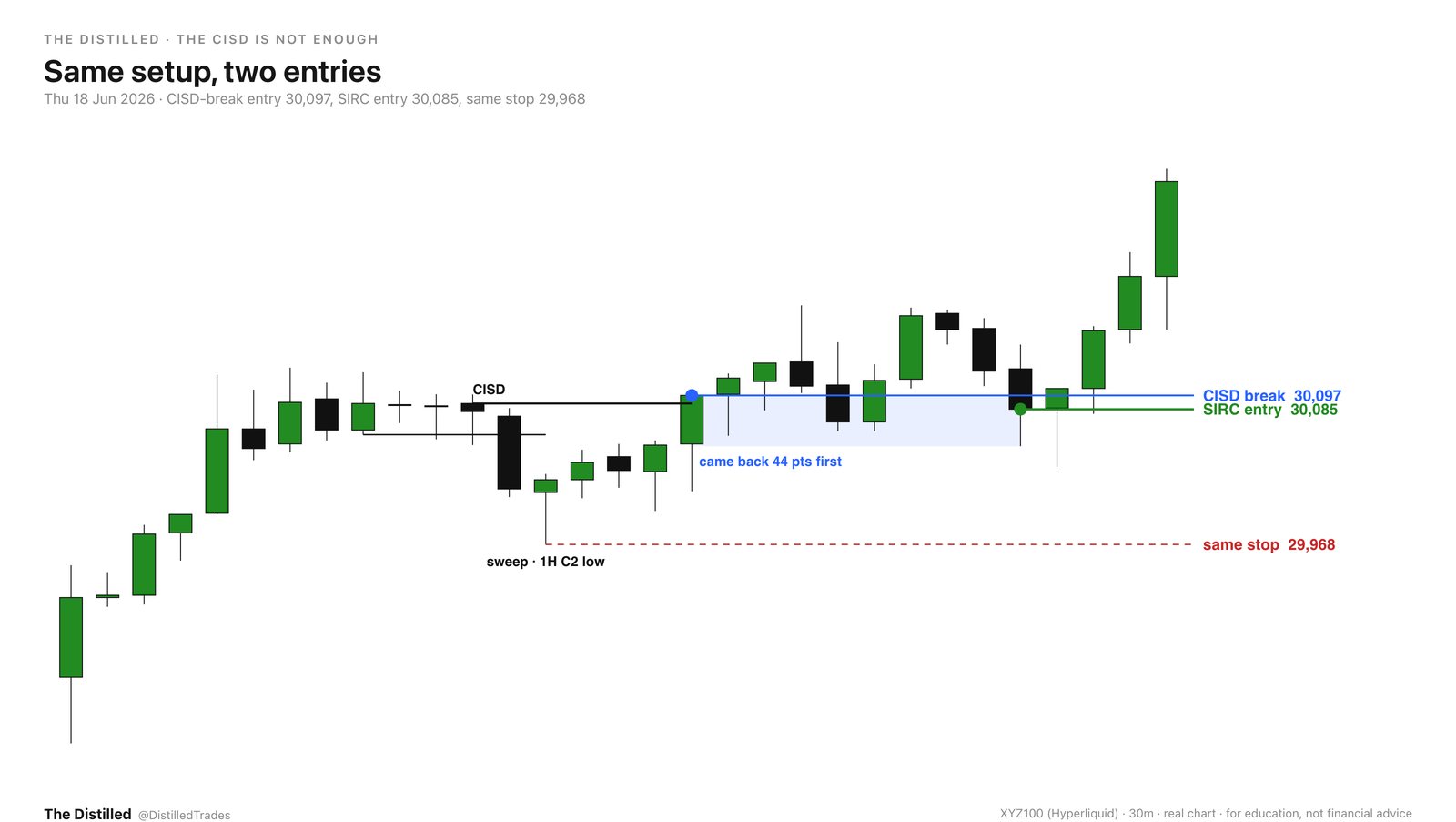
- The close through the CISD usually prints mid-impulse, often on its biggest candle.
- On 123,978 CISD-break entries, 67% came back at least half-way to the stop before +1R.
- Aligned order flow did not change it: 66% with, 67% against.
- SIRC keeps the CISD as confirmation and enters on the retest: same stop, smaller risk.
- Neither entry wins more often; both sit near 1 in 3 at 2R. Waiting sometimes misses the move.
Take your last 20 CISD entries, or find 20 on your chart. For each, write down how far price came back towards the stop before it moved 1R your way, as a fraction of the stop distance. How many came back half-way? For the ones that did, would a retest entry into the gap have existed, and how much smaller would its risk have been?
Related on the site
Education only, not financial advice.